


Ear infections in children are very common, and accounts for many visits to the Paediatrician and other healthcare providers’ offices.
The most common type of infection is middle ear infection, also called otitis media. This infection can follow shortly after the development of acute flu and colds and other conditions like allergies and teething that are characterized by excess mucous from a runny or congested nose. Children are far more prone to middle ear infections than adults and the reason for this is two fold.
The anatomy of children’s Eustachian tubes are different than adults. The Eusthachian tube is an air-circulating passage that can be found between the back of the nose and the air space in the middle ear. In children this little tube is shorter, narrower and more horizontal than in adults, making drainage of air and fluid more difficult. If the nose gets blocked, the fluid produced in the middle ear can’t drain and this fluid build-up in the middle ear space can easily develop a secondary infection.

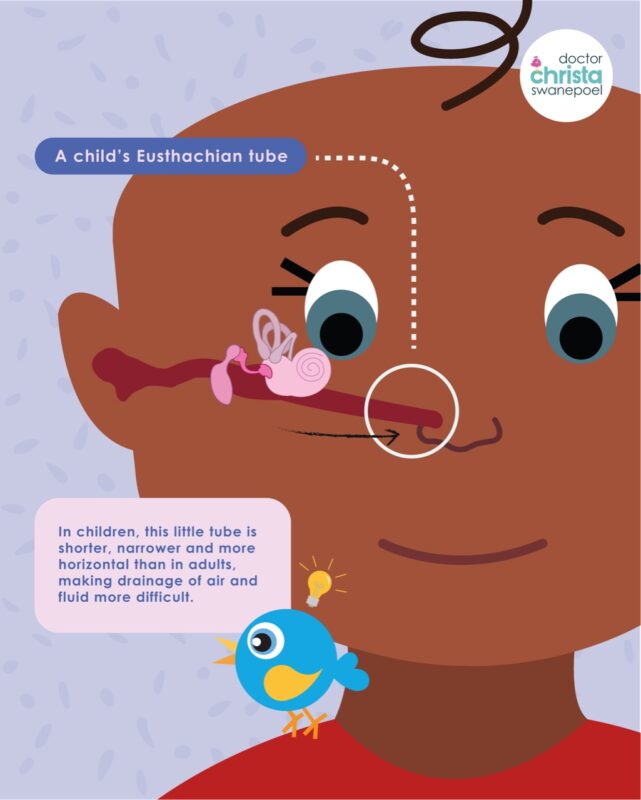

• Children’s adenoids are bigger and this can also prevent drainage from the middle ear, making them more prone to infection.
• Children that are lying down flat and are fed milk or water with the bottle propped up are also at risk for developing middle ear infections. The liquids can collect close to the opening of the Eusthachian tube, blocking it and therefore cause the perfect conditions for an infection to develop. Water running into the ear when bathing or swimming does not cause middle ear infections unless there is a hole in the eardrum.
Symptoms:
Most of the symptoms occur because there is pressure in the middle ear space and this is very painful. Your little ones may have any or all of the following:
• Crying inconsolably or irritability. In some situations the crying may stop suddenly and you could see puss draining from the ear. In this case the pressure was too much and the eardrum has possibly ruptured.
• Disturbed sleeping because the pressure is worse when lying down.
• Tugging on the ear. (Ear infections are only one of the reasons for this symptom. See our earlier post on the various other reasons for this ).
• Complaining of earache if they are older and can verbalise it.
• Fever is present in only some patients; as many as 50% of kids diagnosed with middle ear infection, never have any fever at all.
Treatment:
If you suspect your little one has an ear infection, this is one of the times where I would suggest a visit to your doctors rooms sooner rather than later. Your Paed or GP would usually treat with an antibiotic if your child
• Has severe pain and discomfort
• Is younger than 6 months
• Has ongoing high fevers
• Is visibly unwell
• Has bilateral infections
• Has a history of recurrent infections or other medical conditions
If the middle ear infection is a co-incidental finding or there is not too much fluid, fever and discomfort involved, you doctor may suggest a watchful approach with follow up in 24-48 hours.
Other general measures:
• When they have a middle ear infection your baby may experience pain every time they suckle or swallow. Feed smaller and more regular feeds.
• The pressure in their ears might be relieved a bit by holding them upright. It can often be the first sign a parent notices; baby screams the minute they are put down for a nap or sleep.
• Use Paracetamol or Ibuprofen to help control pain and fever. Do not use Aspirin in any child younger than 9 years.
When do we refer to an ENT surgeon for hearing tubes or grommets?
• If a child has recurrent infections (meaning usually more than 3 infections in 6 months).
• If it takes multiple courses of antibiotics to clear an infection, or there is still residual fluid left in the middle ear space. Sometimes the fluid is so thick in the middle ear space that it can not drain at all. We call this a “glue ear”.
• If your child has speech and language delay or presents with hearing loss secondary to the infection.
• If there is complications like perforations of the eardrum that doesn’t close off spontaneously.
Remember that we are here to help. Contact our office for an appointment if you suspect your little one has an ear infection.
Xoxo
Dr Christa
©️ @drchristas